
Capstone Project
Employment Focused
The MECPS program is focused on preparing graduates for employment in industries such as electronics, aerospace, automotive, biomedical, manufacturing, robotics, security, defense, and construction. Rather than having a research focus, the program will require students to acquire integrative knowledge of systems, as well as hands-on knowledge and experience in an applied domain through a capstone project.
Hands-On Experience
Projects can be individual or group projects. Students will select a particular emphasis area and will be assigned a faculty mentor, or will select a mentor whose area of expertise matches the project’s scope. The project will effectively start with Case Studies in CPS 209 and continue through CPS 210. The project selection process parallels the MS thesis topic selection process in a traditional MS programs, or the senior design project selection process common in engineering programs. In some cases, projects are proposed by students, in other cases by their faculty mentor.
Students’ Crowning Achievement
The Capstone Project is a final independent project that serves as the students’ crowning achievement. It is the culminating academic and hands-on experience for students to showcase their understanding of the material learned and display readiness to enter the field of Embedded and Cyber-physical systems as professionals. Student Capstone Projects are working models or prototypes of an idea. Before graduation, students present their research to their professors, and classmates. Below you can find a database of Capstone Projects completed by graduates. We are extremely proud of our students’ work and their impact on the field of embedded and cyber-physical systems.
Symposium
Presentation
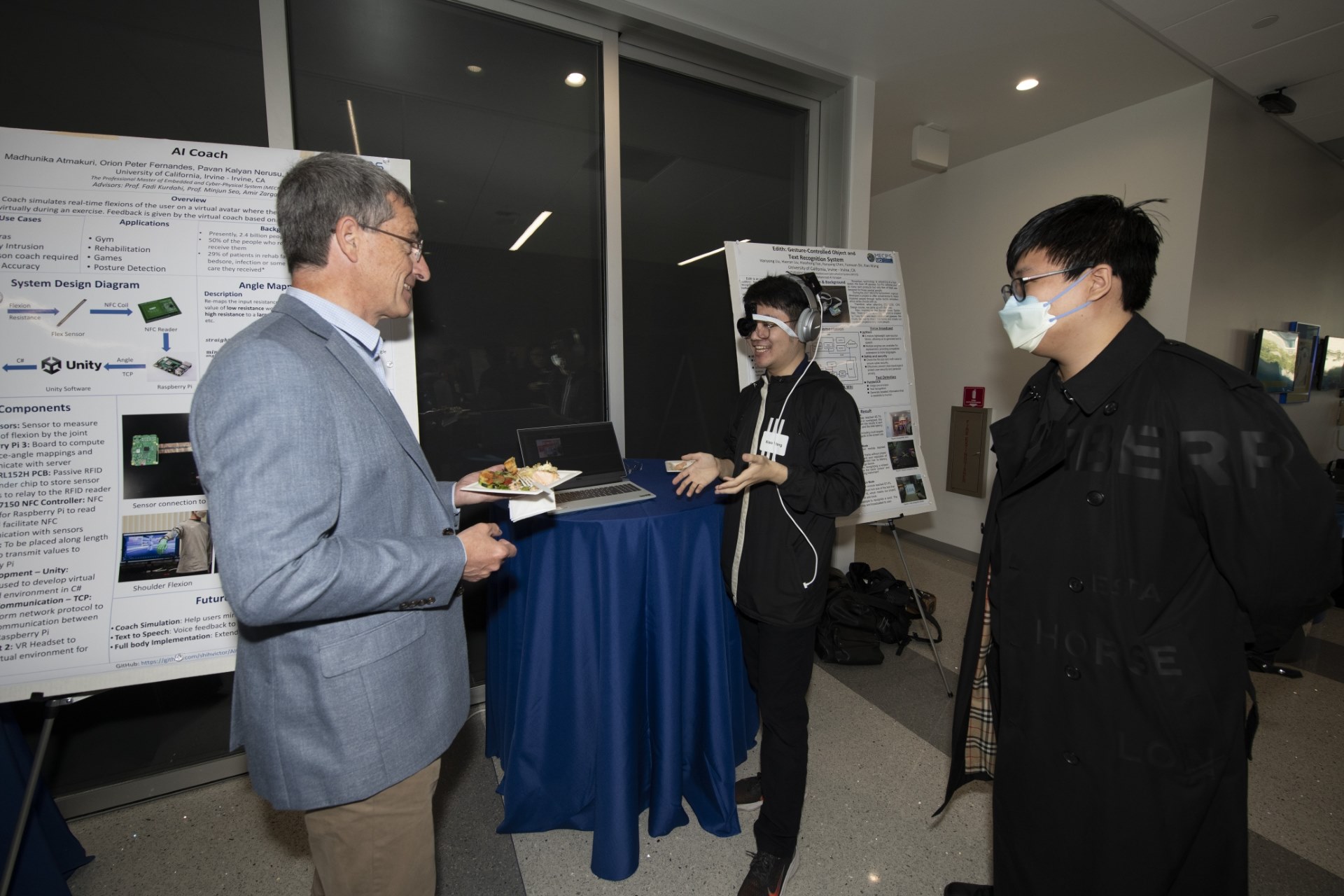
The Symposium offers a unique platform for graduating students to showcase their capstone projects and present them to esteemed faculty members and industry leaders in the local community. This invaluable opportunity allows students to display their hard work and skills while gaining valuable insights and feedback from recognized experts in the field. Students can confidently share their innovative ideas and cutting-edge research, bridging the gap between academia and industry.
Learn More
Watch highlights of our 2022 MECPS Symposium.




Past Project Examples


Academic Year 2025 – 2026
| Agentic AI based on Vision Language Action Models for Robot Navigation |
| AI/ML at the Edge for Police Camera Applications |
| Autonomous HVAC Optimization via ASHRAE 36 and Machine Learning |
| Bioelectric Stimulation, Robotics, and AI/ML Towards Regeneration of the Human Body |
| Cern Device Smart Charge and Decontamination Station |
| Immersive VR Teleoperation for Unitree G1 Humanoid Manipulation |
| Multi-modal Wearable Physiological Monitoring |
| Transformer AI Model Training for Robotic Control on SL2619 |
| VANTAGE: Vision-Assisted Network for Task Allocation and Ground Execution |
| Verification with LLMs using Declarative Prompting |
| Yarn-Based Inline Accelerometer Sensor |
Academic Year 2024 – 2025
| A Smart Maintenance System with Drones and Autonomous Rovers (student proposed) |
| Advanced Elderly Care System Using Amazon Sidewalk and LoRa |
| Advancing End-to-End Autonomous Driving Development with Digital-Twin Simulation |
| Autonomous Rover Navigation |
| Cyber-physical Agentic AI |
| FPGA-based ML Edge |
| Generative AI for Flexible GPIO – AstraIO |
| Mobile Traffic Monitoring |
| Prototyping and Programming a Flexible Precision AI Accelerator on FPGA |
| Quadrotor Racing using Event-Based cameras |
| Revolutionizing Autonomous Driving: Hardware-in-Loop Digital-Twin with Autoware-Apollo |
| Vision-Language Models with Egocentric Gaze Estimation |
Academic Year 2023 – 2024
| FPGA-based ML Edge |
| An Edge-Accelerated UAV Perception Stack for Autonomous Navigation |
| Autonomous Rover Navigation |
| Firefighter Tracking and Communication System in Hazardous Environments |
| Touch Feedback for Virtual Reality |
| Wearable Technology for VR Gaming Integration |
| Physically Accurate Code Generation with Large Language Models for Industrial Control Systems |
| Indoor positioning using Bluetooth 5.1 Radio Direction Finding (RDF) |
Academic Year 2022 – 2023
| Handy: Smart Glove for the Visually Impaired |
| New Disk Pooling Platform attached CXL (Compute Express Link)-based Architecture |
| Dynamic DNN Model Configuration for Adaptive Perception |
| Energy Optimization for Drone Swarms with Graph Neural Networks |
| Smart Parking System |
| Autonomous UAV Swarm for Extensive Surveillance |
| 3D Mapping of indoor spaces using Autonomous Rover |
| Power, Communication, and Control Using NFC and WPT |
| AR Assistant |
| AutoSim Circuit: Open-Source Hardware-in-the-Loop Platform for Autonomous Driving Tests |
| FPGA-based Edge AI Accelerator |
| AGNI – Autonomous Ground Navigation Initiative |
| Zotcare-ChatGPT |
Academic Year 2021 – 2022
| Exploring Response Time and Energy Efficient Tradeoff for Hybrid Polling on Embedded Systems |
| Edith: Gesture-Controlled Object and Text Recognition System |
| Drone swarm & Face tracking |
| AI Coach |
| Development of a Virtual Reality Testbed |
| Development of Autonomous Drone for GPS-less Inspection |
| “Follow-Me” Platform |
Academic Year 2020 – 2021
| Haptic Vision |
| Crowd Avoidance and Social Distance Violation Detection System |
| Distracted Driving Detection |
| Impacts of Water Quality and Variable Flow Rate on Original Nespresso Capsule Machines |
| Scalable Performance/Power Monitoring and Modeling |
| Indoor Positioning and Navigation (IPN) System |
Project Proposal
Is there a project you would like to propose?
Click the button below. It will open up a form where you can share what you would like to see.
Where Our Graduates Are Employeed?