
Explore
About the Program
Our Program
This program is a full-time program lasting four quarters plus summer at the University of California, Irvine. Coursework includes eleven foundational courses with lectures and laboratory, and two project courses leading to a final project. Courses emphasize embedded systems: hardware and software, sensor networks, real-time systems, artificial intelligence, machine learning, security, control and entrepreneurship. To earn the degree, students must complete 48 units including a capstone project. Courses are offered in technology-enhanced form. For more information, view the Master of Embedded and Cyber-Physical Systems (MECPS) Learning Outcomes and check out a recorded informational session.
Custom Designed
The Master of Embedded & Cyber-physical Systems (MECPS) was designed by a group of faculty from the Henry Samueli School of Engineering (HSSoE) and the Donald Bren School of Information & Computer Science (DBSICS). The curriculum focuses on Embedded and Cyber-physical Systems.
Embedded computer systems are now entrenched into almost every aspect of our daily life, rivaling in ubiquity anything that exists today. Currently, we have tools to help us design embedded systems, making good use of available technologies at a variety of levels and scales, from hardware to interface, operating system, middleware, and software. The MECPS program is designed to integrate all of these aspects.
Cyber Physical Systems
Cyber Physical Systems (CPS) is also referred to as Internet of Things (IoT). CPS are systems-of-systems that tightly couple their cyber (i.e. computation, communication and control), and physical components (sensing and actuation) in the context of applications such as (but not limited to): automotive and transportation, manufacturing, power distribution grid, medical and healthcare, robotics, civil infrastructure, avionics, etc. Thus, these Cyber-physical Systems marry knowledge from the fields of embedded systems, networking, sensors, real-time systems and control, as well as domain-specific knowledge to realize systems that are of untapped complexity and scale.
Career Driven
It is predicted that by 2025 over 75 billion devices will connect our homes, buildings, factories, cars, transportation infrastructure, and even our bodies to the Internet. [Source: IHS 2019] This represents close to 10 devices for every living human! It is expected that the economy of Embedded & Cyber-Physical Systems (ECPS) and affiliated industries, or what is now referred to as the Internet of Things (IoT) will exceed $6-14 trillion into the next decade. These numbers give us confidence that graduates who are trained in this domain will be capable of significantly contributing to the engineering community.
Learn More
Fadi Kurdahi shows highlights for a Professional Master of Cyber-physical Systems’s Symposium.
Courses
Plan of Study — Cohort 2025-2026
For students admitted in Fall 2025. Requirements: 6 core courses, proseminar each quarter, 2-quarters capstone project, and 4 electives. The summer quarter is optional and not required for degree completion. UC Irvine General Catalogue 2025-26 Edition Link.

Plan of Study — Cohort 2026-2027
For students admitted in Fall 2026. Requirements: 4 core courses, proseminar each quarter, 2-quarters capstone project, and 6 electives. Some courses that were required for the 2025-2026 cohort are now offered as electives. The summer quarter is optional and not required for degree completion. UC Irvine General Catalogue 2026-27 Edition Link.
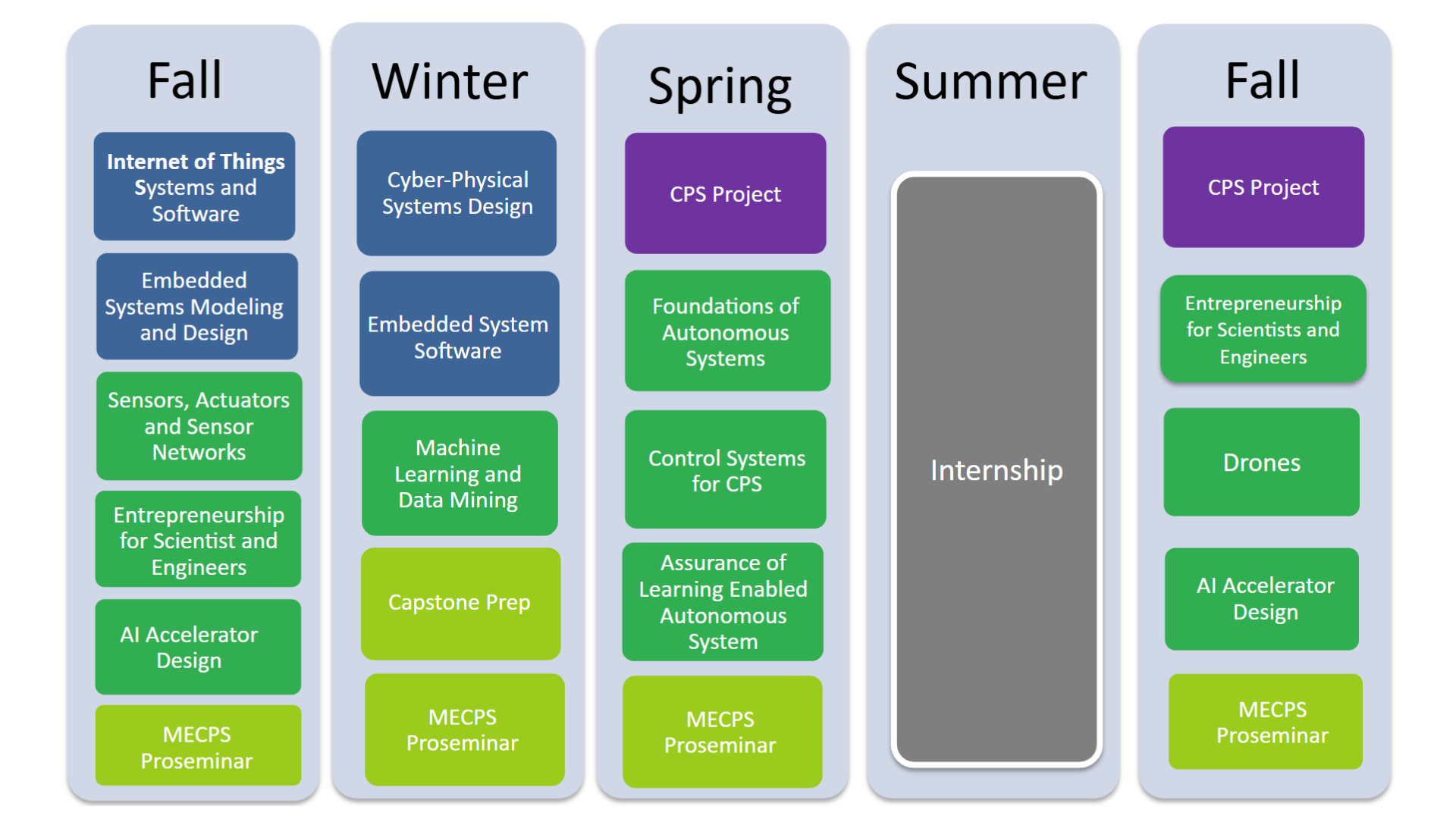
Coursework includes eleven foundational courses with lectures and laboratory, and two project courses (highlighted) leading to a final graduation project. For more information, view the Master of Embedded and Cyber-Physical Systems (MECPS) Learning Outcomes.
ECPS 202: Cyber-physical Systems Design
Description: Model-based design of cyber-physical systems including, e.g. plant, sensing, control, actuation, embedded hardware/software, communication, real-time analysis, various levels of simulation (MILS, SILS, HILS), tools and methodologies for automatic synthesis, and applications from various interdisciplinary domains. The objective of the course is to teach concepts and techniques to design and develop interdisciplinary cyber-physical systems.
Tentative Topics:
- Introduction to CPS and applications
- Modeling dynamic behavior, continuous dynamics
- Discrete modeling and composition of state machines
- Hybrid systems
- Concurrent models of computation
- Embedded Hardware
- Overview of control algorithms and embedded Software
- Multitasking, mapping, and scheduling
- Design Methodologies and tools
- Project presentations, discussion
This course answers the following questions:
- What is a Cyber-Physical System (CPS)? What are the difference and similarities among CPS, Embedded systems, Control systems, Mechatronics, Real-time systems, and Sensor networking disciplines?
- What are the challenges to design a CPS?
- Why are physical modeling and hybrid modeling important to understand CPS systems?
- Why do we need co-simulation techniques to develop a CPS?
- Why is timing concept so important in the CPS design?
- Why is security a critical factor in the CPS design?
- Why does data privacy need to be taken care of in a CPS design?
- What are the potential application areas for CPS:
- Cyber-Physical Energy systems
- Cyber-Physical Medical Systems
- Cyber-Physical Transportation systems
- Cyber-Physical Manufacturing — Digital Manufacturing
Computer Usage: C/C++, Matlab/Simulink and/or Labview and/or Modelica.
ECPS 203: Embedded System Modeling and Design
Credit Units: 4
Description: The goal of the course is to teach students design of custom embedded systems from specification and requirements to architecture and register-transfer level design. The goals will be assessed by homeworks, exams and projects to design particular simple embedded systems. Student should have basic prerequisites algorithms, architecture and operating systems and basic concepts of digital design.
Tentative Topics:
- Embedded systems definition, specification, abstraction levels, requirements, examples
- System Design methodologies, abstraction levels, modeling, synthesis , verification
- Modeling, models of computation, modeling languages, modeling semantics and algorithms, modeling processors levels and communication layers
- System synthesis, transaction level design , platform synthesis, model mapping and estimation
- Software synthesis overview, code generation, multi-task synthesis, internal and external communication
- Hardware synthesis, register-transfer architecture, models and languages, estimation and optimization, datapath and control design, chaining, multi-cycling and pipelining
- Verification, simulation based techniques, formal verification methods, model checking and theorem proving, verification by refinement
- Embedded design practice, system, software, and hardware tools, case studies
Computer Usage: Linux, C/C++ programming, SystemC modeling
ECPS 204: Embedded System Software
Description: Embedded system software requirements, concepts, and examples for applications in the cyber-physical domain. Top-down software design methodology from specification to implementation. Component based design. Real-time and distributed operating systems. Platform independent and hardware dependent software. Cross-compilation, simulation, emulation. The objective of the course is a) to enable student to understand embedded software development and concepts in the cyber-physical world. b) To design, specify, implement and debug embedded software components, and c) To understand dependencies between software components and the underlying physical hardware.
Tentative Topics:
- Embedded software concepts and requirements
- Real-time and cyber-physical requirements
- Real-time operating systems
- Software design methodology
- Design flow from specification to implementation
- Software components and generation
- Platform independent software
- Hardware-dependent software
- Target platforms, processors, devices
- Cross-compilation, simulation, emulation
Computer Usage: Embedded software design tools.
Pre-requirements: Students should have basic programming skills.
ECPS 205: Sensors, Actuators and Sensor Networks
Description: The course focuses on developing a thorough understanding of sensors, actuators and sensor networks spanning deployment, system architecture and communication requirements. MAC protocols, data gathering, routing and queuing are covered by using lectures and a series of specific examples. These illustrate and require the student to understand analysis and design of sensors networks.
Tentative Topics:
- Motivation to use Wireless Sensor Networks.
- Case studies and Applications
- Node Architecture
- Physical Layer
- Operating Systems
- Medium Access Control
- Power Management
- Network Layer
- Time Synchronization
- Localization
Computer Usage: Matlab, C/C++ Programming
ECPS 206: Real-time & Distributed Systems
Description: With the maturity of communication network and Internet connection, all future CPS devices will be designed to be independently running systems with their own sensing, processing and networking capabilities, or as distributed systems. In addition, CPS devices must perform in real time for physical sensing and actuating support. The goal of this course is to build the knowledge in students so that they have the theoretical foundation and practical skill for building future CPS systems. This course covers the principles of building real-time and distributed systems in many hardware platforms and applications being developed for engineering and control as well as for ubiquitous systems and CPS applications. As part of this course, students will learn about real-time and distributed system principle, understand real-time scheduling, operating systems, distributed coordination, and critical resource management. Students will study applications on popular platforms for sensing and control applications. Platforms include networked devices used in application-specific contexts, such as smart sensors and controllers.
Tentative Topics:
- Real-time computing model: system model for real time tasks, timing and performance requirements.
- Real-time scheduling theory: periodic and aperiodic task models, theoretical foundation and scheduling algorithms
- Distributed computing principle: basic network protocols and location transparency to enable resources access within network connection.
- Concurrency coordination: enables several processes and devices to operate concurrently using shared resources without interference between them.
- Failure transparency: enables the concealment of faults, allowing application programs to complete their tasks despite the failure of hardware or software components.
- Performance assurance: methods to allow a system to be configured to guarantee the application performance.
ECPS 207: Security & Privacy in CPS
Description:
As specialized computing devices and components rapidly proliferate into many aspects of everyday life, including: automotive, avionics, household automation, and medicine. This course will cover modern security and privacy issues in Embedded Systems (ES) and Cyber-Physical Systems (CPS). The main goal is for students to attain familiarity with the range of threats and countermeasures facing ES/CPS. Material will include necessary cryptography background for students without prior exposure to that topic, as well as a primer on security protocols. The core of the course will focus on recent developments in security and privacy in ES/CPS. As this is a fast-moving field with constant research advances, the exact list of topics is expected to change every few years. Students are expected to know basic ES/CPS concepts and have some familiarity with Operating Systems and Networking.
Tentative Topics:
- Introduction to ES/CPS, Overview of Terminology and Basic Concepts in Security & Privacy
- ES/CPS Security Threats, Examples of Concrete Attacks, Lessons Learned
- Side-Channel Attacks: range and mitigation techniques
- Security Protocols involving ES/CPS components
- Midterm exam, Project mid-point review
- Public key and symmetric cryptography, Key management
- RFID devices: unique privacy and security considerations
- Remote Attestation Techniques: Software- and Hardware-based
- Physically Unclonable Functions (PUFs), their applications and limitations
- Review of covered material, Project Presentations
ECPS 208: Control Systems for Cyber-physical Systems
Description: Analysis of structural vibration of mechanical systems. Modeling for lumped and distributed parameter systems, free and forced vibrations, Fourier series, convolution integral, mass stiffness matrices, and normal modes with design project. Prerequisites: Systems/Signal (e.g., and Linear Algebra). The goals of the course are Analysis of structural vibration of mechanical systems. Modeling for lumped and distributed parameter systems, free and forced vibrations, Fourier series, convolution integral, mass stiffness matrices, and normal modes with design project.
Tentative Topics:
- State space representation (continuous and discrete)
- Input-output representation and their relationships to state space models
- Stability
- Controllability and observability
- Pole placement, deadbeat controllers, LQR and model predictive control
- Introduction to optimization for linear systems: constrained and unconstrained problems
- Application of optimization for control of CPS: MPC, decentralized optimization and collaborative control of multi-agent systems
- Case studies: car charging protocol, demand shifting in district cooling
Computer Usage: Matlab
Pre-requirements: Systems/Signal (e.g., and Linear Algebra). Students are expected to know Elementary differential equations and linear algebra. Student should have taken a basic course in systems and signals, in both continuous and discrete time domains (Laplace and Z Transforms).
ECPS 209: Cyber-physical Systems Case Studies
Description: Seminar course covering CPS case studies in application areas such as: GPU programming, smart manufacturing, automotive and transportation, power distribution grid, medical and healthcare, robotics, civil infrastructure, and avionics.
Example Topics:
- Module 1: Smart and Connected Health
- 3 week Module
- Module 2: Smart Home Applications
- 3 week Module
- Module 3: Transportation CPS
- 3 week Module
ECPS 210: Cyber-physical Systems Project
Description: Students are required to complete a project that deals with a specific emphasis of Cyber-Physical Systems. This can be in applications such as (but not limited to): automotive and transportation, manufacturing, power distribution grid, medical and healthcare, robotics., civil infrastructure, avionics.
Tentative Topics:
- To design, build and test a cyber-physical system.
- Identify a problem and formulate a strategy to solve it in a systematic fashion with given constraints of time, budget and other resources.
- Generate necessary project reports such as project proposal, project time-line, design reports, final reports, etc.
- Work in teams.
- Consider the economic, environmental, social, political, ethical, health, safety, regulatory, security and privacy impact of their final product.
Prerequisites: ECPS 202 or ECPS 203 or ECPS 216
ECPS 211: Fundamentals of Machine Learning and Artificial Intelligence
Description: The study of theories and computational models for systems which behave and act in an intelligent manner. Fundamental subdisciplines of artificial intelligence including knowledge representation, search, deduction, planning, probabilistic reasoning, natural language parsing and comprehension, knowledge-based systems, and learning.
Tentative Topics:
- Knowledge representation
- Search deduction
- Planning
- Probabilistic reasoning
- Natural language parsing and comprehension
- Knowledge-based systems
ECPS 212: Entrepreneurship for Scientists and Engineers Systems
Credit Units: 4
Description: Real-world introduction to the theory and practice of entrepreneurship. Explore organizational, strategic, and financial challenges; start-up strategies; business idea evaluation; and business plan writing. Presentations by prestigious entrepreneurs and industry leaders.
Tentative Topics:
- Technology entrepreneur
- Building a business plan and presentation:reasons, form, and content
- Identifying a business idea opportunity
- Building a competitive advantage
- Business innovation strategies
- Core competencies and outsourcing strategy
- Marketing and sales plan
- Leadership of entrepreneurial organizations
- Legal formation of a company and intellectual property
- Sources of capital funding for start-ups
- Exit strategies for investors
ECPS 215: Foundations of Autonomous Systems
Credit Units: 4
Description: This course will introduce the fundamentals of perception, planning, and control of autonomous systems. Students will learn how to use Robotic Operating Systems (ROS), integrate data from various sensors (e.g. IMU, LiDARs, and Cameras) while implementing algorithms for localization, planning, mapping, and control of autonomous vehicles. The course will cover both model-based and machine learning algorithms for realizing autonomous systems.
Tentative Topics:
- Introduction to Robotic Operating System, ROS nodes
- Rospy Build System, ROS Services, ROS Launch
- ROS Bags, and Robotic Simulation using Gazebo, Localization: Odometry
- Motion Planning: PID control, Search Algorithms.
- Motion planning: Configuration Spaces, Sampling Methods
- Motion planning: RRT and RPM planning
- Localization: Extended Kalman Filter, Scan Matching,
- Localization: Simultaneous Localization and Mapping (SLAM), Hector SLAM, and Particle Filters.
- Machine Learning: Introduction to ML, Basic Classifiers, Neural Networks
- Machine Learning: Imitation Learning and Reinforcement learning
ECPS 216 Internet of Things Systems and Software
Credit Units: 4
Description: This course focuses on the Internet of Things (IoT) concept, sensors and actuators, serial protocols, network and communication protocols and programming, IoT platforms, real-time performance, middleware architecture for IoT, edge and cloud support for IoT applications.
Tentative Topics:
- IoT Introduction
- WiFi IoT Devices
- Serial & Socket Communication
- Rapid GUI Prototyping
- Cloud Services
- IoT Web Communication Framework
Computer/Lab Usage:
- Basic soldering of sensor connectors
- Arduino/Sketch, Python, and C Programming
- Web/IoT Framework Programming
ECPS 295: Special Topics in CPS
Credit Units: 4
Description: Studies in selected areas of CPS. Topics addressed vary each quarter.
Example: GPU Parallel Programming – Drones – Assurance of Learning Autonomous System – AI Accelerator Design
Learn More
Watch a video from the ECPS 203 Drone Flight Project.
Capstone Project
Internships
Industry Experience
During the summer quarter, students can either engage in an industry sponsored internship or decide to focus on their graduation project, both of which will provide students with valuable training to secure future engagement with industry. Throughout the program, we organize a number of events that allow students to interact with industry representatives.
Build Your Resume
Our students, 29.2%, have received job offers before graduation.
After graduation, 31.5% of our students were hired within 3 months in industries including IoT Stack Design, Firmware Engineering, Cloud Programming, Defense Systems, Home Automation, Information Technology, Software Engineering and Software Development. In addition, 16.9% were employed within 3 to 6 months, and an additional 1.1% were employed after 6 months. Furthermore, 1.1% enrolled in a PhD program.
Cyber Physical Systems
Science of Embedded Systems
As these systems grow in scale, complexity, and integration levels, there is a need to move towards a science of embedded systems, addressing the foundational aspects of design. Now that we have a better understanding of the basics of embedded systems, it is equally important to branch out to the application of such systems. This requires addressing domain-specific issues and the scale-up in complexity introduced by what is referred to today as Cyber-physical Systems.
Systems-of-Systems
Cyber-physical Systems (CPS) are systems-of-systems that tightly couple their cyber (i.e. computation, communication and control), and physical components (sensing and actuation) in the context of applications such as (but not limited to): automotive and transportation, manufacturing, power distribution grid, medical and healthcare, robotics, civil infrastructure, avionics, etc. Thus, these Cyber-physical Systems marry knowledge from the fields of embedded computer systems, networking, sensors, real-time systems and control as well as domain-specific knowledge to realize systems that are of untapped complexity and scale.

Domains in CPS
The following domains have been identified as major areas in CPS (although other areas are constantly being added to the list):
- Advanced Manufacturing: smart production equipment, processes, automation, control, and networks; new product design.
- Transportation/Automotive: intelligent vehicles and traffic control, intelligent structures and pavements.
- Smart Infrastructure: smart utility grids and smart buildings/ structures, civil infrastructure, smart homes.
- Health Care: body area networks and assistive systems, elderly home care and monitoring, networked implantable devices.
- Emergency Response and Cyber-Enhanced Security: detection and surveillance systems, situational awareness, communication networks, and emergency response equipment.
- Sustainable development: Water, pollution, waste, etc.
NIST Report
A key report commisioned by the National Institute of Standards and Technology (NIST) states the importance of CPS, recommends transformative ideas, and points to a major barrier.
…a key visionary element of the future of education for CPS is the availability of recognized educational programs that offer the fundamentals of CPS though a multi-disciplinary curriculum…
…Lack of a CPS degree that cuts across multiple disciplines, hindered by stove piped nature of university structure…
First of Its Kind
This degree is a first in the US to focus on both Embedded and Cyber-physical Systems.
Being managed by a center that falls at the intersection of Engineering and Computer Science disciplines, it overcomes the hindrances observed by the NIST report discussed above.
Our graduates have an integrative knowledge of fundamentals that include software, hardware, sensing, and actuation control and hands-on knowledge through practical projects in a targeted application domain.
Well Rounded Education
Graduates of Computer Science and/or Engineering are ideally suited to apply and enter the MECPS program.
In recent years, we find that as undergrads work on senior design projects they get familiar with Embedded and Cyber-physical Systems and gain an appreciation for the domain. Indeed, many of these students state that hands-on knowledge of systems is a highlight of their educational experience at UCI, and want to see more of it in the future. The MECPS program directly addresses that point.
Learn More
Fadi Kurdahi explains more about Cyber-Physical Systems.
Careers
Our Graduates Have Exciting Careers
After graduation, 31.5% of our students are hired within 3 months in industries including IoT Stack Design, Firmware Engineering, Cloud Programming, Defense Systems, Home Automation, Information Technology, Software Engineering and Software Development.
Even before graduation, 29.2% of our students are receiving job offers.
%
Received job offers before graduation
%
Employed within 3 months
%
Employed between 3 and 6 months
%
Employed after 6 months
%
Enrolled in PhD Program
%
Not Tracked/Reported
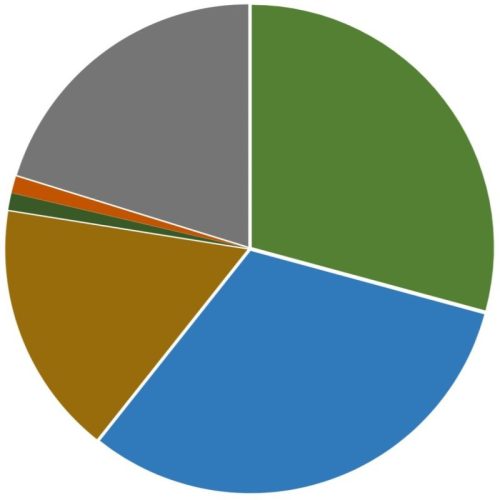
Employment Statistics 2021 - 2024
I am also involved in engineering curated, repeatable, vertical IoT solutions as proof of concepts for Ingram Micro’s own brand of IoT solutions in verticals like Fleet management, Retail, Environmental, Smart Building, Healthcare, Logistics.
The MECPS degree at UC Irvine has been the wind beneath my wings (just to put it in a sentence). It gave me the domain knowledge about Cyber Physical Systems popularly called IoT (Internet of Things) these days and the right skills through a well thought out custom made program structure that gave me the best of both worlds – Hardware and Software. It also gave me the opportunity to apply all the skills gathered through the course of the program, in a capstone project.
Get started with your new career!
Career Services
A focus of this program is to provide information, skills, and tools needed for students to land an exciting job in the domain of cyber-physical systems. The Associate Director of Career Services for MECPS provides workshops and advising on topics such as: resumes and cover letters, networking, job search, interviewing, negotiation, and helps identify and develop soft skills employers are looking for. Throughout the program you will receive access to company site visits, employer info sessions, and gather insight from industry professionals. The Division of Career Pathways provides additional career resources for the entire UCI community.
Learn More
Watch someone talk about careers.